




An in-house milling workflow can allow dental labs processing a large volume of implants to exercise more control over quality, schedule and cost of abutments production. For that to happen, the lab should have the right scanning, CAD implant libraries, CAD/CAM system, CAM software, five-axis machine tool, proper fixtures, cutting tools, and inspection workflow.
Is It Possible to Mill Titanium Abutments Efficiently in House?
Yes, a laboratory that has the right equipment and knows how to utilize it can mill titanium abutments effectively and reproducible, provided that it uses pre-milled blanks and proper machining and inspection techniques. But for the lab to achieve this kind of efficiency, it should start from designing an optimal production process. One of the key goals of a high-quality production process is consistent output: constant production cycle, clean surfaces, repeatability of geometry, controlled wear of tools and quality control.
It is true that in-house production of abutments can bring additional benefits for labs that process large numbers of implants, allowing them to control their rush cases better. However, every implant component produced should comply with all material, implant-component, software, equipment and regulatory requirements.
Product and Service Overview
Titanium abutment milling is the digital manufacturing service that is used to produce implant-specific titanium abutments. Typical system for abutment production includes scanning device or approved digital case input, CAD implant software, CAM software, a five-axis dental milling machine, coolant management, fixtures that are suitable for the production, cutting tools, blanks of titanium or cobalt-chromium and inspection tools.
Axsys Dental Solutions provides a range of open dental CAD/CAM solutions that is specifically designed for dental laboratories and milling centers. It includes Versamill five-axis machining centers, dental CAD and CAM software, fixtures, tooling, materials of titanium and cobalt-chrome, implant components, training and technical support. Instead of treating a milling machine as a single purchase, Axsys can help design the whole production process that corresponds to the indications, production volume, software and personnel of a laboratory and its further development.
Premilled Titanium Blanks versus Full-Disc Production of Titanium Abutments
There are two approaches to the abutment production:
- Titanium premilled abutments are manufactured by the component supplier and delivered to the laboratory, which produces customized coronal and emergence profile.
- Titanium discs give the producer wider opportunities in the design of abutments and production of them but take more time and effort from the producer.
Premilled blanks provide an easier way of producing customized one-piece abutments for many laboratories. Choice of the approach depends on authorization, platform compatibility, design freedom, equipment capabilities, traceability, throughput and quality system of the lab.
Reasons to Use Titanium as the Material for Abutments
Titanium is widely used in implant prosthetics thanks to its mechanical properties such as high strength, corrosion-resistance, lightness and biocompatibility. Titanium is a good material to make thin and durable designs in case of necessity, but it is not easy to machine titanium.
During cutting process, heat concentration takes place close to the cutting edges of the tool. Rigidness of the setup, inappropriate parameters, coolant delivery, worn tools, fixturing can cause vibrations, deflections of the tool, rough surfaces and reduce its lifetime. Efficient titanium dental milling process requires all elements of the manufacturing system, not just the ability of the machine to cut titanium.
Features Required for High-Volume Titanium Abutment Milling Process
It is important for a production laboratory to take into consideration the features that allow getting the consistent output during long working shift, not just the best possible outcome during the demonstration of the machine.
- Machine rigidness: it is necessary for the machine to have a rigid frame and precision guideways that help resist the vibration during the work.
- Capable spindle: proper torque, power, speed range, and low runout can help achieve the efficient cutting and surface quality.
- Five-axis simultaneous movement: multi-axis control allows reaching difficult locations and managing tool orientation.
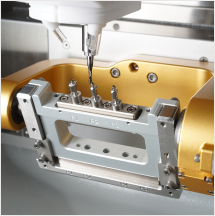
- Stable fixturing of pre-milled blanks: the setup should ensure repeatable positioning to guarantee precision during loading, unloading and re-loading of the fixturing.
- Coolant delivery: constant coolant flow can help with heat management and chip evacuation during wet titanium milling.
- Dental CAM strategies: the proven toolpaths should balance the cycle time, finish, process stability and tool life.
- Automatic tool management: proper tool capacity, tool breakage detection and clear rules of replacement.
- Automation options: multi-position fixtures, blank changer/loader can increase productivity of the machine after the approved jobs are queued.
- Open architecture: compatibility with existing dental software and file workflows protects the integration decisions.
Automation is valuable if it goes along with reliable upstream case data and downstream quality control. Loaders can multiply the number of good products but also can multiply the setup error that was made unconsciously. High-volume labs need release criteria and traceability that correspond to the capacity of the machine.
Benefits of Milling Titanium Abutments In-House
Greater Control over Turnaround Time
In-house production eliminates an external manufacturing stage for qualified cases. The lab can prioritize urgent cases, react to the changes in the design and schedule its capacity according to the actual due date. This opportunity can be very helpful for a case that would otherwise wait for shipping or manufacturing queue.
Consistent Digital-to-Manufacturing Communication
Designers and machine operators work from the same prescription, scan, CAD file and case notes. Any question regarding margin placement, emergence profile, restorative space and material can be clarified inside the lab before the machine starts operating.
Better Use of Skilled Labor
Once the job is released after the validation procedure, the machine performs repetitive milling operation. The technicians should be responsible for design approval, setup, finishing, inspection, maintenance and exceptional handling of the job but they can handle several production tasks, not individually shaping every component.
More Predictable Cost and Capacity
Labs can measure the material usage, cycle time, tool consumption, labor, machine utilization and remake rates by case type. This kind of information helps to estimate price of the product and show the laboratory if addition of another fixture, shift or automated machine can help in increasing production.
Stronger Customer Service
Reliable in-house production capacity allows providing shorter lead times and better status updates. It also can help a lab offer custom titanium abutments along with crowns, hybrid restorations, bars and other implant-related services as an integrated process.
If titanium cases outgrow your current workflow, Axsys Dental Solutions can help you to compare the machine capacity, premill fixtures, CAM solutions, tooling and automation according to your monthly volume.
Uses and Applications
Titanium milling machine can be used for different products depending on the machine, software, components, materials and validated process. Some of the applications include:
- Patient-specific titanium abutments
- Premilled abutments for compatible implant platforms
- Custom and hybrid abutment processes
- Screw-retained implant components
- Bars and overdenture frameworks
- Titanium bridges or substructures
- Other components of cobalt-chrome where it is supported
- Prostheses, jigs or production aids that are approved for the process
High-volume labs should classify those applications in process families. Premilled abutments can share fixture and tooling, but bars made from discs can require different strategies, cycle time and inspection procedures.
Titanium Abutment Milling Process
1. Validate the Prescription and Digital Inputs
Make sure that the implant platform, component family, restoration type, tissue information, restorative space, screw channel requirements and records are correct. Scan data should be complete and accurately oriented. Production team of the lab should stop the case in case of lack of information instead of trying to solve clinical ambiguity at the mill.
2. Design the Custom Abutment
Using the dental CAD software, a skilled designer should develop the emergence profile, margin, angulation, height and restorative support. The design has to fit into the permissible geometry of the component supplier and software library. The designer has to check the minimum thickness, cement space if it is required, tool accessibility, opposing clearance and planned restoration before releasing it.
3. Select the Correct Blank and Library
Match the physical blank, implant platform, interface, holder position and digital library. Even though similar looking components may look like interchangeable, they are not. Use the controlled inventory labels and lot traceability for the possibility of linking the finished abutment to the original material and production record.
4. Prepare the CAM Job
Import the approved design, select the correct machine and fixture, orient the component and use the validated titanium strategy. The CAM job should include definition of tools, feeds, speeds, stepovers, coolant requirements and finishing passes. Simulation helps to identify any collisions, unreachable geometry or unexpected material before the machining starts.
5. Load, Probe and Mill
Make sure that the fixtures and connection surfaces are clean, securely install each blank with the specified torque or other method and check its position that was measured. Make sure that the coolant is there, the tool is in good condition, offsets are correct and machine capacity is sufficient. Automated probing or calibration can help in improving setup repeatability, but operator should verify that the physical load corresponds to the digital job.
6. Finish and Inspect
Remove the component according to the validated process, clean and finish the component without damage of the implant interface. Check critical dimensions and surfaces with appropriate calibrated measuring tools. Document the acceptance, nonconformity and any rework of the component. A component should not advance simply because it looks good to naked eye.
7. Release and Retain Records
Connect the component with its prescription, design, material lot, machine job, inspection results and responsible personnel. Retaining the digital records helps to maintain consistency, investigate the remake, respond to the customer questions and constantly improve the process.
Titanium Premill Abutments
Titanium pre-milled abutments can be very helpful for labs who wish to customize their products without machining implant connections from raw material. The supplier creates and preserves the connection while the laboratory machines the patient-specific upper geometry. This process can save the material and simplify the production process, provided that blank, implant library, holder and strategy of machining are properly matched.
Axsys Dental Solutions offers DESS pre-milled blank options that are called Titanium Grade 5 ELI. This product is meant for compatible implant platforms and is described in Axsys’s product information as precise connection and screw seating. Labs have to check the compatibility, authorization, component instructions and indications for every platform before the production.
How to Increase Throughput Without Sacrificing the Quality
Efficient output is achieved by eliminating the variability between jobs. Such practices usually matter more than pushing the particular toolpath to the limits of its speed:
- Group compatible jobs: batch by component family, fixture, material, tooling and due date in order to reduce the changeovers.
- Standardize the CAM templates: control the approved strategies by machine, material, blank and indication; restrict any unapproved changes of parameters.
- Manage the tools by data: track the life of the tool by material and strategy and replace it before the wear affects dimensions or surface of the component.
- Stage the work offline: prepare the design, blanks, documentation and next job while the machine is working.
- Use primary and backup operators: cross-training prevents the whole process from dependence on one person.
- Plan the preventive maintenance: perform cleaning, coolant service, calibration, spindle checking and fixture inspection before the performance becomes unpredictable.
- Measure the first-pass yield: track the accepted parts, remakes, rework, tool failures, setup time, cycle time and unplanned downtime.
Lights-out or weekend production should be introduced gradually. Start from the stable and low-risk batches; set the tool-life margins; verify coolant and chip capacity; define how the team will react to the alarms. Unattended production is profitable if the process is already predictable.
Quality-Control Considerations for Implant Components
Abutments require higher level of quality control than any generic milled component. Inspected features of an implant component may include:
- Correct implant platform, blank and CAD library
- Preserved and undamaged connection geometry
- Condition of the screw channel and its seating
- Margin, emergence profile and restorative clearance
- Conformity with the dimensions of the approved design
- Surface finish and absence of defects
- Complete removal of chips, coolant and processing residue
- Material lot, machine job and operator traceability
- Final approval by authorized personnel
Inspection methods should be appropriate for the tolerance and risk of inspected feature. Calipers cannot validate every critical interface of the component. Labs have to use the instructions of the component supplier, appropriate calibrated measuring tools and quality system according to the products they manufacture.
Why Choose Axsys Dental Solutions?
Axsys Dental Solutions brings together machines, software, fixtures, tooling, materials, education and support. Such system approach is helpful for a lab that wishes to scale titanium production without creating integration problems between vendors.
The published Axsys options that are relevant to the high-volume implant production include:
- Versamill AX500L: five-axis dental milling machine with 12 disc auto-loader, titanium capability, zero point fixturing and fixture for premilled abutments. According to the Axsys, this machine’s storage system can accommodate up to 72 premilled blanks, depending on the setup.
- Versamill AX726DW | PRO: designed for labs and milling centers with higher production requirements. Features wet/dry machining, 2.7 kW spindle, 16-station automatic tool changer and available 18-position robotic work changer and fixtures for six titanium premilled abutments.
- Versamill 5X200: compact five-axis wet/dry system that is targeted for titanium custom abutments and other dental indications. Features rigid frame, closed-loop motion, 6 mm tooling and CAM options.
- Open software and workflow choices: Axsys supports the established dental CAD/CAM solutions and can help to adjust the machining templates according to the equipment, material and restoration.
- Training and technical support: implementation guidance will help to develop repeatable setup, machining, maintenance and troubleshooting processes.
The best option is not necessarily the machine with the largest loader. Axsys can help to evaluate the case mix, desired unattended hours, floor space, utilities, operator skill, existing software, implant platforms and future production requirements in order to make the recommendation.
Checklist for a High-Volume Laboratory before Launching or Expanding Titanium Production
Verify that the business has:
- Estimated monthly volume by platform and case type.
- Confirmed CAD libraries, blanks, fixtures and software compatibility.
- Documented CAM strategies and change control.
- Defined inspection equipment and acceptance criteria.
- Calculated tooling, coolant, labor, maintenance and financing costs.
- Assigned trained primary and backup operators.
- Planned spare tools, critical consumables and technical support.
- Completed test cases and process qualification before routine release.
Start from controlled batch of cases, review the results in 30, 60 and 90 days and expand only after meeting the quality and delivery requirements.
Conclusion
Abutment milling can help the high-volume dental lab to gain control over turnaround, capacity and customer service. Advantage comes from the stable digital manufacturing process: correct data, compatible components, rigid five-axis machine, coolant delivery, reliable tools, proven CAM strategies and quality inspection.
Develop a titanium production process that works consistently – not just produces good demo. Contact Axsys Dental Solutions at (855) 687-7941 to discuss Versamill equipment, premill fixtures, CAD/CAM software, tooling, training and automation for your laboratory.